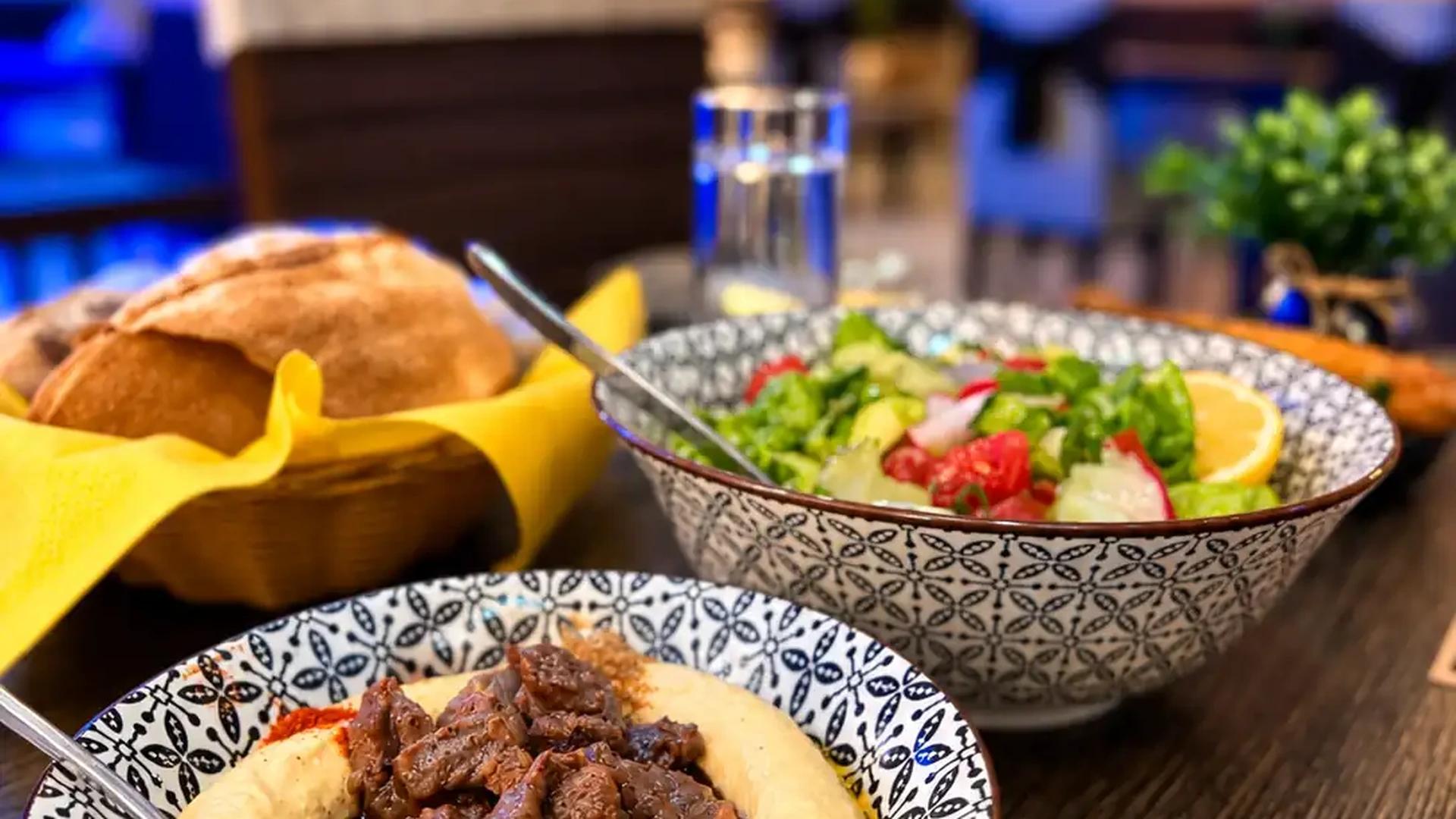
Lebanese mezze is not one particular dish. It is a way of eating in which several smaller dishes are placed on the table and shared.
A mezze selection can include dips such as hummus and mutabal, fresh salads such as tabbouleh, hot dishes such as falafel and kibbeh, vegetables, pastries and Arabic bread.
Variety is part of the idea. Instead of building the entire meal around a single plate, different flavours and textures can appear on the table at the same time.
This is why mezze is one of the best ways to understand Lebanese cuisine and the tradition of the shared table.
What is Lebanese mezze?
Lebanese mezze is a selection of small cold and hot dishes that are usually placed on the table for sharing.
It can include dips, salads, vegetables, pastries, falafel, kibbeh and other dishes.
There is no single combination that defines what mezze must look like. A small selection may contain only a few dishes, while a larger table can bring together many different flavours.
This is also why the word “appetiser” does not fully describe the idea.
Mezze can introduce a meal, but when the selection is varied enough, it can also become the main part of the meal itself.
Are mezze and appetisers the same thing?
Not quite.
An appetiser is usually understood as a separate dish served before the main course. Mezze is a broader idea: several dishes can be placed on the table at the same time and shared.
That means you do not necessarily have to finish the hummus before moving on to the salad and then wait for the hot dishes.
Hummus, mutabal, tabbouleh, falafel and kibbeh can all be on the same table, allowing everyone to try different combinations.
That freedom is an important part of the Lebanese mezze tradition.
Which dishes can be part of Lebanese mezze?
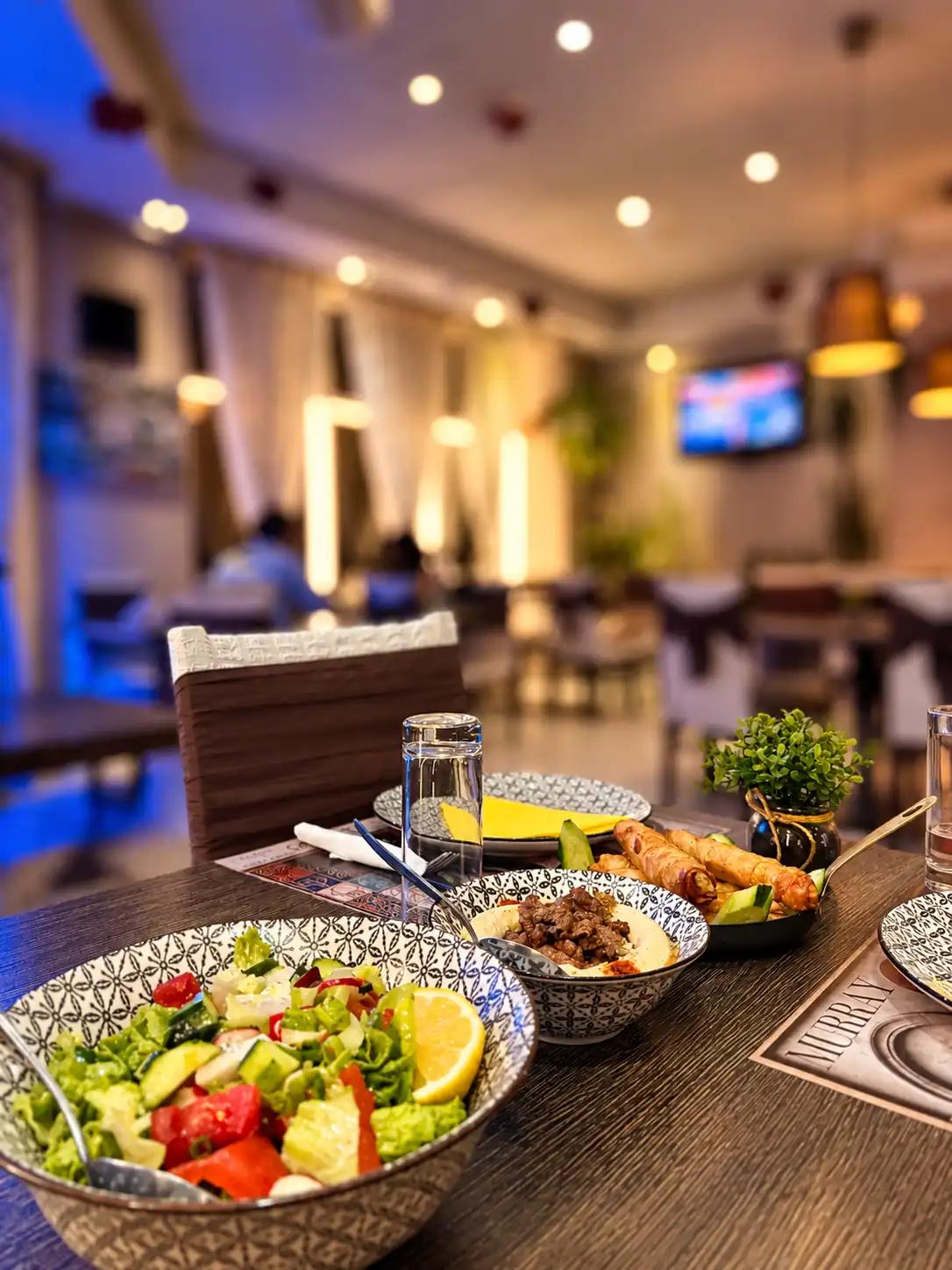
Mezze can bring together several different categories of food.
Common examples include:
- cold dips;
- fresh salads;
- hot mezze;
- vegetable dishes;
- pastries;
- Arabic bread;
- sauces and accompaniments.
This does not mean that every mezze table needs to include all of these categories.
What matters more is that the dishes can be combined and shared.
Hummus, mutabal and muhammara: the cold side of mezze
Cold dips are often one of the first parts of a Lebanese mezze selection.
Hummus
Hummus is a dip based on chickpeas and tahini.
Its creamy texture makes it a natural companion to Arabic bread, vegetables and other mezze.
At Murray, the classic hummus is made with chickpeas, tahini, lemon and olive oil.
Mutabal
Mutabal is an aubergine-based dip, commonly combined with tahini.
Although hummus and mutabal can both contain tahini, their main ingredients are different, which gives them different flavours and textures.
On Murray’s menu, the dish is listed as Moutabal.
For a closer look at the ingredients, flavour and difference from hummus, read our guide to what mutabal is.
Muhammara
Muhammara adds another distinct flavour profile to the cold mezze selection.
On Murray’s current menu, it is listed as Mhmara and described with hot peppers, onion, tomato sauce, lemon, tahini and coriander.
When hummus, mutabal and muhammara are placed together, it becomes clear why Lebanese mezze should not be understood as several versions of the same dip.
Each dish contributes something different to the shared table.
What role do salads play in mezze?
Fresh salads bring acidity, herbs and crisp textures alongside creamier or richer dishes.
Two characteristic examples are tabbouleh and fattoush.
Tabbouleh places parsley and fresh herbs at the centre. Bulgur is present, but in traditional Lebanese-style tabbouleh it plays a supporting role.
On Murray’s menu, the dish is listed as Tabouleh.
For a closer look at the dish, read our guide to traditional Lebanese tabbouleh.
Fattoush has a different character. On Murray’s menu, it is listed as Fattouch and includes lettuce, tomatoes, cucumbers, radishes, peppers and crispy bread.
Salads therefore do more than add another plate to the table. They create contrast with tahini-based dips, fried mezze and richer hot dishes.
What are hot mezze?
Hot mezze show another side of the Lebanese table.
They can include dishes based on legumes, bulgur, meat, pastry or potatoes.
Falafel
Falafel is made from legumes and herbs and has a characteristically crisp exterior.
At Murray, falafel is made from chickpeas and herbs and served with tahini sauce.
It can be combined with hummus, salads and Arabic bread as part of a larger mezze selection.
Kibbeh
Kibbeh refers to a group of dishes in which bulgur is commonly combined with meat and other ingredients.
The version at Murray is stuffed and includes minced beef and lamb, bulgur, onion and nuts.
Kibbeh therefore brings a very different texture and flavour to the table compared with falafel or cold dips.
Arayes, sambousek and batata harra
Hot mezze extend far beyond falafel and kibbeh.
Murray’s menu also includes:
- Arayes: Arabic bread filled with minced beef;
- Sambousek: filled pastry, with cheese and meat versions available;
- Batata Harra: spicy potatoes with garlic and coriander.
These dishes show how varied the textures and flavours on a mezze table can be.
What role does Arabic bread play?
Bread is not simply a side dish.
With dips such as hummus and mutabal, Arabic bread is a natural way to combine and share different dishes.
Pieces of bread can be used with dips or served alongside salads and other mezze.
In this way, bread helps connect the different parts of the table rather than leaving each dish completely separate.
How is Lebanese mezze shared?
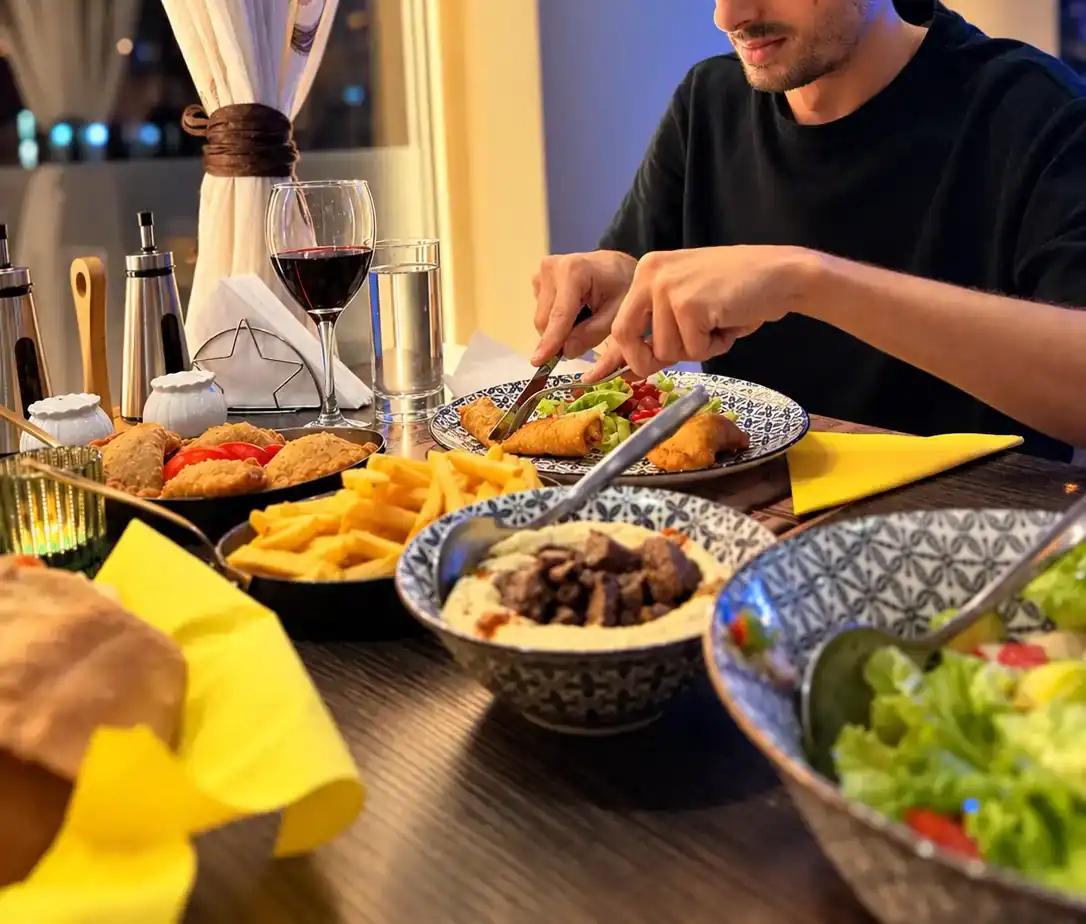
There is no complicated ritual you need to learn before eating mezze.
Several dishes are placed in the middle of the table and everyone can try them according to their preferences.
One person may start with hummus and bread, another with tabbouleh, and both may then move on to falafel or kibbeh.
Not everyone needs to eat the same dish at the same time.
That is one reason mezze works so naturally as a shared meal: each person can discover their own combination of flavours while the food remains a collective experience.
How many mezze dishes should you order?
There is no universal number.
It depends on:
- how many people are at the table;
- whether mezze are the beginning or the main part of the meal;
- whether you plan to add grilled or other main dishes;
- the size of the individual portions;
- everyone’s appetite.
For that reason, there is no single combination we would describe as the “correct” one.
A more practical approach is to choose from different categories rather than ordering several very similar dishes.
For example, you might combine a dip, a salad and one or two hot mezze, then add a grilled dish if you want a larger meal.
If you are new to the cuisine, see our practical guide to what to order at a Lebanese restaurant for the first time.
How can you combine different flavours?
One of the strengths of mezze is contrast.
Instead of choosing several similar dishes, you can bring together different flavours and textures:
- creamy: hummus or mutabal;
- fresh and herb-led: tabbouleh;
- fresh and crisp: fattoush;
- warm and crisp: falafel;
- richer and meat-based: kibbeh or arayes;
- spicy and potato-based: batata harra.
This is not a rule. It is simply an easy way to build a more varied table.
The contrast between the different dishes is part of what makes mezze interesting.
Can mezze be the whole meal?
Yes.
If the selection is varied enough, cold and hot mezze can make up an entire meal.
A combination of hummus, mutabal, salad, falafel, kibbeh and bread already brings together several different flavours, temperatures and textures.
On another occasion, mezze can be the beginning of a meal followed by shawarma, shish taouk, kafta or another grilled dish.
Both approaches work.
This is why it is more useful to think of mezze as a way of sharing and combining food rather than as one fixed category of “appetisers”.
Lebanese mezze at Murray Restaurant in Sofia
In the Murray Restaurant menu, you can build a mezze selection from several different categories.
Current options include Homous, Moutabal, Mhmara, stuffed vine leaves, Tabouleh, Fattouch, Falafel, Kibbeh, Arayes, Sambousek and Batata Harra.
You do not need to order all of them.
A more interesting approach is to choose several different flavours and share them across the table.
A dip can be paired with a fresh salad, hot mezze and Arabic bread, with a grilled dish added if you want a larger meal.
Murray Restaurant is located at 70 Kozloduy Str., Banishora, Sofia, close to Sofia Central Railway Station.
If you would like to try Lebanese mezze as part of a shared meal, you can book a table at Murray.