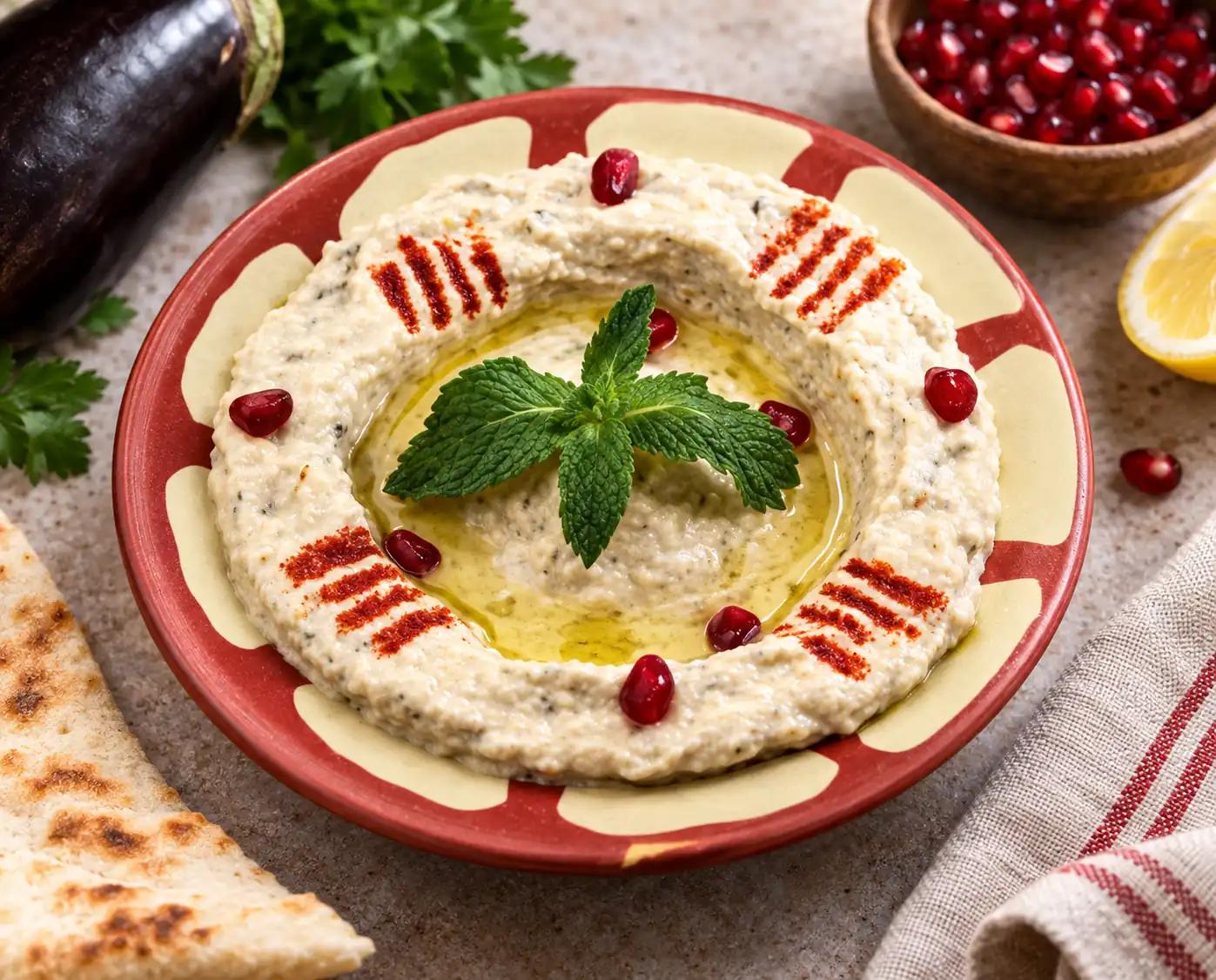
Mutabal is a dip made with roasted aubergine and tahini, commonly associated with the cuisine of the Levant. Lemon and garlic are usually added, while the roasted aubergine gives the dish a soft, sometimes distinctly smoky flavour.
If you have mainly associated Lebanese food with hummus so far, mutabal is a natural next dish to try as you explore Lebanese mezze.
At first glance, the two dips can look quite similar. Both may contain tahini and lemon, and both are commonly served for sharing. The main difference, however, is very simple:
hummus is based on chickpeas, while mutabal is based on aubergine.
The difference in the main ingredient gives each dip its own distinctive flavour, aroma and texture.
What is mutabal?
Mutabal belongs to the wider tradition of Levantine mezze, a style of eating found in Lebanon and other parts of the Levant. Mezze brings a variety of small dishes, dips and salads to the table for sharing.
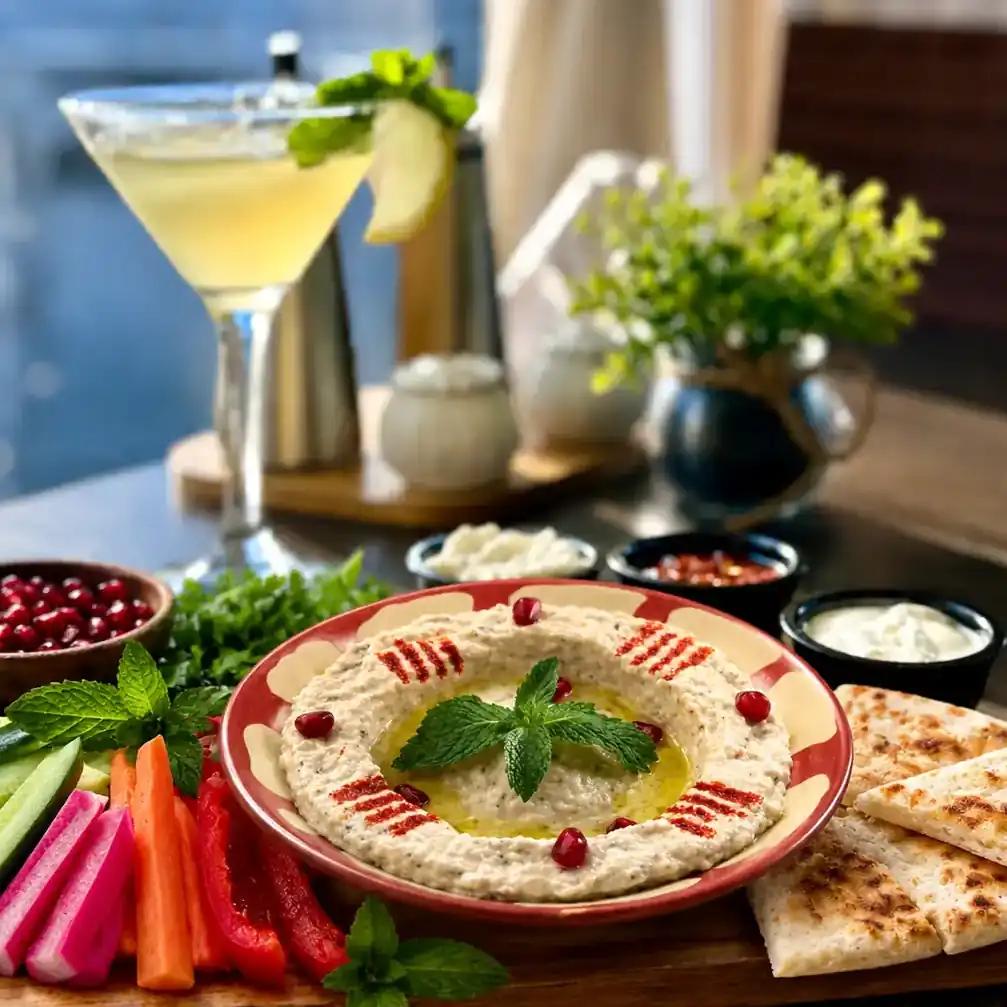
The most recognisable versions of mutabal use aubergine as their base. The aubergine is usually roasted thoroughly, and in some preparations direct contact with flame is used to create a stronger smoky aroma.
The softened flesh is then combined with tahini, lemon juice and garlic.
There are different family and regional variations, so exact proportions and additional ingredients may differ. For that reason, it is more accurate to speak of a typical mutabal profile rather than one single mandatory recipe.
You may also see the name written as mutabal, mutabbal, moutabal or moutabel. These different spellings usually reflect different ways of transliterating the Arabic name into the Latin alphabet.
What is mutabal made from?
Common versions of mutabal usually include a few main ingredients:
- aubergine;
- tahini;
- lemon juice;
- garlic;
- salt;
- olive oil for seasoning or serving.
Some recipes also include yoghurt, while others leave it out completely.
The most important part is the relationship between the aubergine and the tahini.
Aubergine provides the main vegetable character and often a lightly smoky note. Tahini adds richness and the distinctive flavour of sesame. Lemon balances that richness with acidity, while garlic brings a sharper aromatic note.
What does mutabal taste like?
Mutabal usually has a soft, creamy and lightly smoky flavour profile.
How noticeable the smoky character is depends largely on how the aubergine is prepared. When it is cooked directly over a flame or heavily charred, the smokiness can become much more pronounced. With other roasting methods, the flavour tends to remain gentler.
Tahini adds sesame richness, lemon brings fresh acidity, and garlic contributes its characteristic aroma.
This is what sets mutabal apart from hummus from the very first bite. Although the two dips share some ingredients, their bases are completely different.
What is the difference between mutabal and hummus?
The easiest way to distinguish mutabal from hummus is by looking at their main ingredient.
Mutabal is based primarily on aubergine, usually combined with tahini and lemon. Its flavour is vegetable-forward, sesame-rich and often slightly smoky, especially when the aubergine has been cooked over a flame. The texture is creamy but may retain a little more structure from the aubergine itself.
Hummus, on the other hand, is based on chickpeas. Tahini is one of its defining ingredients, while lemon adds freshness and balance. Its flavour is earthier and more chickpea-forward, with a clear sesame note, and its texture is usually smooth, rich and creamy.
In short: mutabal is an aubergine-based dip, while hummus is a chickpea-based dip. Tahini and lemon create some similarity between them, but the different main ingredient determines the character, flavour and texture of each.
The distinction is also clear in the menu of Murray Restaurant in Sofia. Hummus is made with chickpeas, tahini, lemon and olive oil, while mutabal is based on aubergine combined with tahini, garlic and fresh lemon flavour.
Are mutabal and baba ghanoush the same thing?
The answer is a little more complicated.
In different countries, restaurants and culinary traditions, the names mutabal and baba ghanoush are sometimes used interchangeably. In other contexts, a distinction is made between the two.
Under one common distinction, mutabal refers to a creamier combination of roasted aubergine and tahini, while baba ghanoush may describe an aubergine mixture containing vegetables, herbs or other seasonings.
The terminology, however, is not completely consistent everywhere.
For that reason, looking for one universal distinction that applies to every country and every recipe is not particularly useful. It is more accurate to look at the actual ingredients of the dish.
If a menu lists aubergine, tahini, lemon and garlic, that is the flavour profile most commonly associated with mutabal.
How is mutabal served?
Mutabal is commonly served as part of mezze and may share the table with other cold dips, salads and warm dishes.
This is also one of the best ways to understand its flavour.
When you taste mutabal on its own, the aubergine, tahini and acidity of the lemon come to the foreground. When hummus is served beside it, the difference between an aubergine-based dip and a chickpea-based dip becomes much clearer.
A fresh salad such as tabbouleh or fattoush can provide contrast, while the meal can naturally continue with shawarma, shish taouk, kafta or another grilled dish.
This also highlights one of the defining features of Lebanese mezze: the individual bowls are not necessarily separate “starters” that need to be finished one after another. They can remain on the table and be combined with the rest of the meal.
Where can you try mutabal in Sofia?
In the current menu at Murray Restaurant in Sofia, mutabal is listed among the cold mezze and is described as finely prepared aubergine with tahini, garlic and fresh lemon flavour.
Murray Restaurant is located at 70 Kozloduy Str., Banishora, Sofia, close to Sofia Central Railway Station. Here you can try mutabal on its own or as part of a broader selection of Lebanese food, including mezze, salads and grilled dishes.
The menu also includes a Trio Appetizer, bringing together hummus, mutabal and muhammara. For someone discovering Lebanese cuisine for the first time, this combination has one practical advantage: the three dips can be compared directly at the same table.
Hummus highlights the character of chickpeas and tahini, mutabal puts aubergine at the centre, while muhammara introduces a third and very different flavour profile.
For a closer look at what sets each dip apart in ingredients, flavour and texture, explore our comparison of hummus, mutabal and muhammara.
What goes well with mutabal?
If you are trying mutabal for the first time, there is no need to build a complicated order around it.
One simple combination is:
mutabal + hummus + tabbouleh or fattoush
This gives you two very different dips on the same table - one based on aubergine and the other on chickpeas - together with the fresh contrast of a salad.
If you want a fuller meal, you can add a grilled dish after the mezze. Mutabal can remain on the table and be enjoyed alongside the other elements of the shared meal.
Mutabal or hummus - which should you choose?
If you enjoy aubergine and smokier flavours, mutabal will probably be the more interesting choice.
If you prefer the richer taste of chickpeas or are already familiar with hummus, hummus remains the more familiar starting point.
But there is no particular reason to choose only one.
Mutabal and hummus are different enough to be ordered together. Comparing them side by side is one of the easiest ways to understand how two creamy dips that may look similar can taste completely different.
If you would like to try mutabal and other Lebanese dishes in Sofia, you can book a table at Murray.
For a selection of Lebanese mezze to enjoy at home or at the office, explore the Murray to Go - Lebanese Mezze Box.