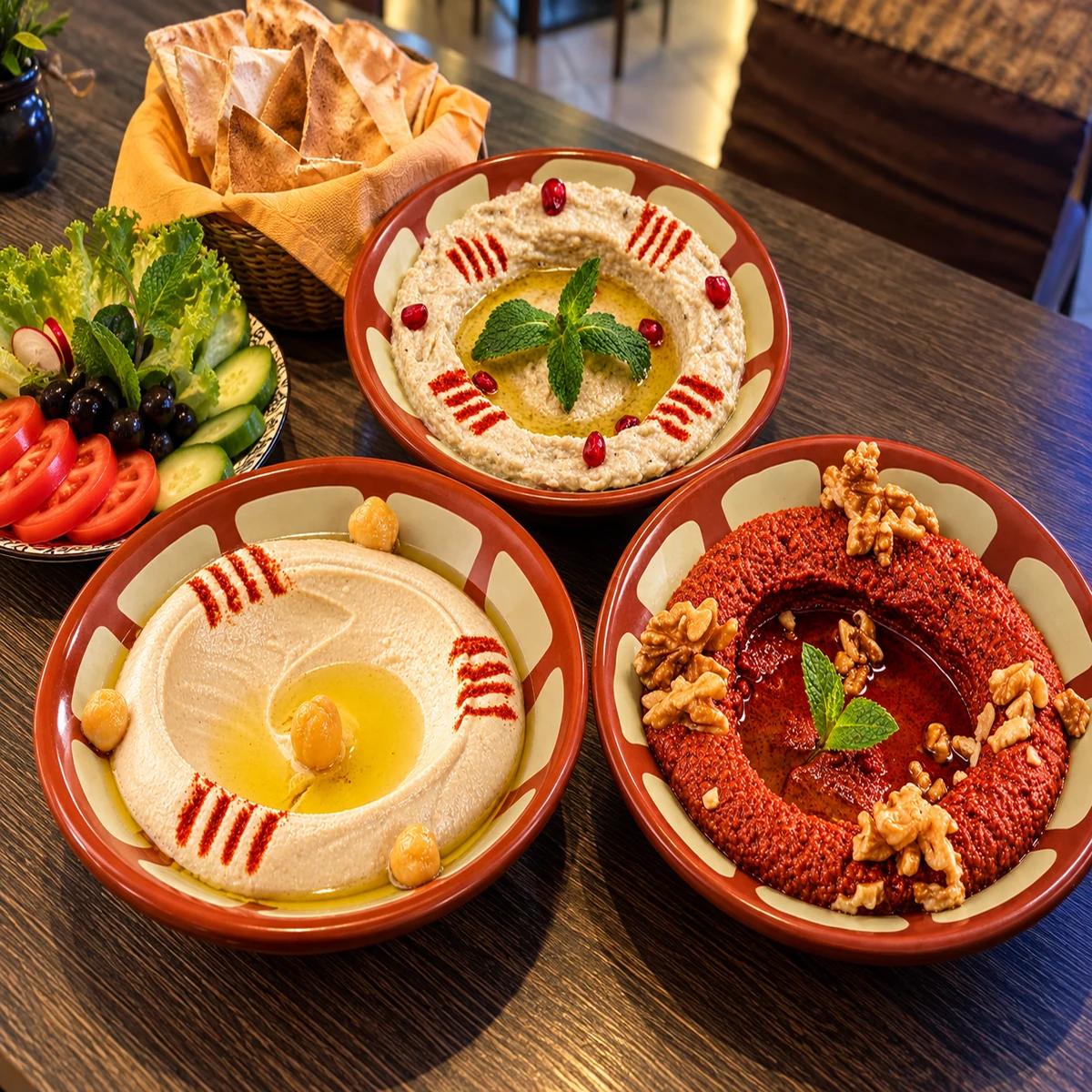
Hummus, mutabal and muhammara often appear side by side on a mezze table, but they are not three versions of the same dip. Each starts with a different main ingredient, and that changes its flavour, aroma, colour and texture.
The easiest way to remember the difference is simple: hummus is based on chickpeas, mutabal on aubergine, and muhammara on peppers.
If you are just beginning to explore Lebanese cuisine, comparing these three dips is a useful way to see how varied a shared mezze table can be.
What is the difference between hummus, mutabal and muhammara?
Hummus, mutabal and muhammara are three distinct dips that can all be served as part of Lebanese mezze. Hummus is mainly based on chickpeas and tahini, mutabal on aubergine and tahini, while muhammara is a pepper-based dip. Their different foundations give each one its own flavour, aroma and texture.
Hummus
- Main ingredient
- chickpeas
- Tahini
- a defining ingredient
- Flavour profile
- earthy, sesame-rich and fresh
- Texture
- smooth and rich
- At Murray
- chickpeas, tahini, lemon, olive oil
Mutabal
- Main ingredient
- aubergine
- Tahini
- commonly used
- Flavour profile
- aubergine-forward, creamy, sometimes lightly smoky
- Texture
- creamy and soft
- At Murray
- aubergine, tahini, garlic, lemon
Muhammara
- Main ingredient
- peppers
- Tahini
- depends on the version; used at Murray
- Flavour profile
- more intense, often spicy or sweet-spicy depending on the recipe
- Texture
- varies with the recipe
- At Murray
- hot peppers, onion, tomato sauce, lemon, tahini, coriander
| Hummus | Mutabal | Muhammara | |
|---|---|---|---|
| Main ingredient | chickpeas | aubergine | peppers |
| Tahini | a defining ingredient | commonly used | depends on the version; used at Murray |
| Flavour profile | earthy, sesame-rich and fresh | aubergine-forward, creamy, sometimes lightly smoky | more intense, often spicy or sweet-spicy depending on the recipe |
| Texture | smooth and rich | creamy and soft | varies with the recipe |
| At Murray | chickpeas, tahini, lemon, olive oil | aubergine, tahini, garlic, lemon | hot peppers, onion, tomato sauce, lemon, tahini, coriander |
Tahini can create some similarity between these dips, particularly hummus and mutabal, but it is not what defines them. The clearest distinction comes from the main ingredient: chickpeas in hummus, aubergine in mutabal and peppers in muhammara.
Hummus vs Mutabal: What’s the Difference?
Hummus and mutabal can both be pale, creamy and made with tahini and lemon. At first glance, that can make them look surprisingly similar.
Their main ingredients, however, are completely different.
Hummus is built around chickpeas. They give it a fuller, earthier flavour, while tahini adds the characteristic sesame note.
Mutabal is based on aubergine. Its flavour is more vegetable-forward, and when the aubergine is cooked over flame or strong heat, it may also develop a lightly smoky character.
In short:
hummus = chickpeas
mutabal = aubergine
Tahini and lemon may connect the two, but the different main ingredient is what gives each dip its own identity.
How is muhammara different from hummus and mutabal?
Muhammara belongs to a different flavour family altogether.
While hummus relies on chickpeas and mutabal on aubergine, muhammara gets its main character from peppers. This usually gives it a deeper colour and a more pronounced flavour.
Muhammara recipes are not identical everywhere. Widely known versions may include red peppers, walnuts and pomegranate molasses, with the balance of sweetness, acidity and heat varying from one recipe to another. A contemporary recipe by Lebanese restaurateur Kamal Mouzawak, for example, combines charred red peppers, walnuts, pomegranate molasses and tahini.
That does not mean every muhammara is made with the same ingredients.
On Murray’s current menu, muhammara is described as a spicy dip made with hot peppers, onion, tomato sauce, lemon, tahini and coriander. Walnuts are added as a garnish when the dish is served.
This is why it is useful to distinguish between a general description of a dish and the specific recipe served by a particular restaurant.
What does hummus taste like?
Hummus has a relatively mild, rich and creamy flavour.
Chickpeas provide the foundation, while tahini adds sesame depth and a slightly nutty character. Lemon brings freshness and helps balance the richness.
Murray’s classic hummus is made with chickpeas, tahini, lemon and olive oil.
For someone already familiar with hummus, it can be a useful starting point for exploring other Lebanese dips - from the more aubergine-forward character of mutabal to the stronger flavour of muhammara.
What does mutabal taste like?
Aubergine is the defining ingredient in mutabal.
Tahini adds body and sesame flavour, garlic brings a more aromatic note, and lemon adds freshness.
Depending on how the aubergine is prepared, mutabal may also have a gentle smoky character. This is one of the features that can make it noticeably different from hummus even when the two look similar.
At Murray, Moutabal is described as blended aubergine with tahini, garlic and lemon.
If you enjoy aubergine and prefer a more vegetable-forward dip, mutabal is clearly distinct from hummus despite the fact that both may contain tahini.
What does muhammara taste like?
Muhammara usually has a more intense flavour profile than hummus or mutabal.
The exact balance depends on the recipe. Different versions may lean more towards sweetness, acidity or heat.
At Murray, muhammara is described as spicy and is made with hot peppers, onion, tomato sauce, lemon, tahini and coriander. Compared with the hummus and mutabal served at Murray, it therefore has the most clearly pronounced spicy profile.
Hummus, mutabal or muhammara - which should you choose?
There is no single best choice. It depends on the flavour you are looking for.
Choose hummus if you prefer a rich, creamy dip with chickpea and sesame notes.
Choose mutabal if you enjoy aubergine and want a more vegetable-forward flavour that may also carry a gentle smoky note.
Choose muhammara if you are looking for something more intense and enjoy peppers and a spicier flavour profile.
And if you want to understand the difference properly, there is no particular reason to choose only one. These three dips are different enough to work well side by side.
Can hummus, mutabal and muhammara be served together?
Yes. Their differences are exactly what makes them suitable for the same mezze table.
Lebanese mezze is not simply a collection of similar starters. Different dips, salads and warm dishes can be placed on the table together and shared as part of the same meal.
Hummus brings chickpeas and tahini. Mutabal puts aubergine at the centre. Muhammara introduces peppers and a more intense flavour.
Because their main ingredients and flavour profiles are different, the three can complement one another rather than repeating the same taste.
How can you compare all three at Murray?
On the current Murray menu, hummus, mutabal and muhammara can each be ordered separately.
They are also available together as the Trio Appetizer.
That makes it easy to compare them at the same table: the chickpea base of hummus, the aubergine character of mutabal and the spicy pepper profile of muhammara can all be tasted side by side.
Hummus also appears in other forms on the menu, including Homous with Meat, made with chickpeas and tahini, lemon, fried beef, nuts and olive oil. That is a separate dish, but it also shows how hummus can serve as a base for richer combinations.
For a first comparison between the three dips, however, classic hummus, mutabal and muhammara give the clearest contrast.
In short: how can you tell them apart?
If you remember only one thing, make it this:
Hummus is based on chickpeas.
Mutabal is based on aubergine.
Muhammara is based on peppers.
Other ingredients shape the final flavour and recipe, but this basic distinction is the easiest way to understand the difference between the three.
Where can you compare hummus, mutabal and muhammara in Sofia?
If you would like to compare the three beyond the descriptions, Murray serves hummus, mutabal and muhammara both separately and together as the Trio Appetizer.
Murray Restaurant is located at 70 Kozloduy Street, Banishora, Sofia, close to Sofia Central Railway Station.
You can browse the current Lebanese menu before your visit, or reserve a table at Murray if you would like to try the three dips side by side.