Muhammara is a spicy Levantine dip strongly associated with the culinary tradition of Aleppo in Syria. It is commonly based on red peppers, while many traditional versions also include walnuts and pomegranate molasses. Often served as part of Lebanese mezze, muhammara differs from hummus and mutabal in its main ingredients, texture and flavour.
At Murray Restaurant in Sofia, muhammara has its own spicy preparation featuring hot peppers, tomato sauce and sesame tahini. Walnuts are used as a garnish when the dish is served.
If you are just discovering Lebanese mezze, muhammara is a good example of how one shared table can bring together dips with very different bases, textures and flavours.
What is muhammara?
Muhammara is a thick, spicy Levantine dip commonly based on roasted red peppers. In one of its most widespread forms, the peppers are combined with walnuts, breadcrumbs and pomegranate molasses, creating a sweet-and-sour flavour with a rich nutty character.
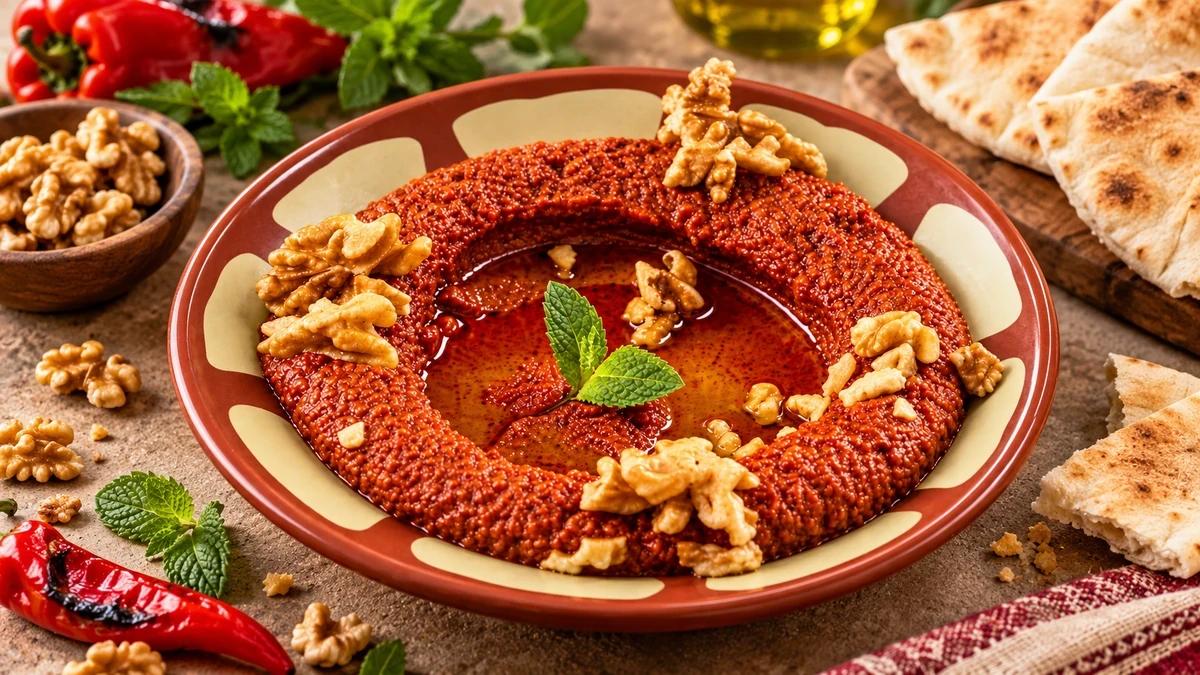
Its texture is often coarser and more textured than hummus, and it is traditionally served with pita as part of a mezze spread.
There is no single universal recipe for muhammara. Ingredients, proportions and levels of heat can vary between regions, households and restaurants. It is therefore more accurate to think of muhammara as a distinct dip with its own flavour profile rather than a dish defined by one fixed list of ingredients.
What is muhammara made from?
Muhammara recipes vary, but many widely known versions include:
- red peppers;
- walnuts;
- pomegranate molasses;
- olive oil;
- aromatic or hot red peppers;
- lemon, garlic and cumin.
Depending on the recipe, bread or breadcrumbs and additional spices may also be used.
Roasted peppers provide the main vegetable base and a mild natural sweetness. Walnuts add richness and a nutty flavour, while pomegranate molasses contributes a sweet-and-sour note. Hot peppers and spices determine how aromatic and spicy the final dip becomes.
Not every muhammara contains walnuts and pomegranate molasses as part of the dip itself. At Murray, for example, the version is based on hot peppers, tomato sauce and sesame tahini, while walnuts are used as a garnish when the dish is served. More about Murray's version can be found below.
What does muhammara taste like?
Muhammara usually has a rich, spicy and slightly sweet-and-sour flavour, although the exact profile depends on the recipe.
In common versions made with red peppers, walnuts and pomegranate molasses, the sweetness of the peppers is combined with the richness of the walnuts, the acidity of the pomegranate molasses and varying levels of heat from peppers and spices.
Compared with the milder flavour of hummus and the distinctive character of mutabal, muhammara often has a brighter and more pronounced spicy profile.
Is muhammara spicy?
Muhammara can be spicy, but there is no fixed level of heat. Some versions are relatively mild, while others place hot peppers much more prominently at the centre of the flavour.
On the Murray Restaurant menu, muhammara is marked as spicy and uses hot peppers as a main ingredient, so the heat is more noticeable in this particular version. If you prefer milder flavours, start with a small amount and combine it with hummus.
Where does muhammara come from?
Muhammara is strongly associated with Aleppo in northern Syria, a city known for its rich culinary tradition and Aleppo pepper. The name “muhammara” comes from Arabic and can be translated roughly as “reddened” or “made red”, reflecting the characteristic colour of the dip.
Today, muhammara is prepared across different parts of the Levant, including Lebanon, Palestine and Jordan, with ingredients and proportions varying between local and family traditions.
This is why muhammara can also appear as part of Lebanese mezze. You can read more about the wider culinary context in our guide to Lebanese cuisine.
For that reason, it is more accurate to describe muhammara as a Levantine dip with a strong connection to Aleppo rather than as a dish belonging exclusively to one modern national cuisine.
How is muhammara served?
Muhammara is commonly served as a dip, often at room temperature, in a small bowl or plate. It is usually eaten with pita or another type of Arabic flatbread and can also be served with raw vegetables such as cucumber or carrot.
As part of mezze, muhammara can remain on the table alongside other dips and dishes rather than being treated only as a separate starter that must be finished before the rest of the meal.
Its spicy profile allows it to work alongside milder dips, fresh salads and richer grilled dishes.
This is one of the defining features of Lebanese mezze: dips, salads and hot dishes can stay on the table together and be shared throughout the meal.
Are muhammara, hummus and mutabal the same?
No. Muhammara, hummus and mutabal are different dips with different bases, flavours and textures.
Hummus is based on chickpeas and tahini.
Mutabal is primarily associated with aubergine and tahini.
Muhammara is centred on peppers, while many widely known versions also include walnuts and pomegranate molasses.
The easiest way to distinguish the three is by their base:
- hummus - chickpeas and tahini;
- mutabal - aubergine and tahini;
- muhammara - peppers, with additional ingredients varying according to the recipe.
For a more detailed look at their ingredients, flavours and textures, read our comparison of hummus, mutabal and muhammara.
What is the muhammara at Murray Restaurant in Sofia like?
On the Murray Restaurant menu, the dish is listed as “Mhmara” and appears among the Cold Mezze. The portion is 200 g, it is marked as spicy, and its ingredients are:
- ground hot peppers;
- onion;
- tomato sauce;
- lemon;
- sesame tahini;
- coriander.
Walnuts are used as a garnish when the dish is served.
This particular version is a good example of how traditional dishes can have different restaurant interpretations.
The muhammara served at Murray should not be presented as the only traditional version of the dish. Muhammara has regional, family and restaurant variations, while the Murray Restaurant menu describes the specific version served at the restaurant in Sofia.
How should you try muhammara for the first time?
If you have never tried muhammara before, one of the easiest ways to understand its flavour is to compare it with other familiar dips from Lebanese mezze.
Hummus is a useful starting point because its chickpea-and-tahini base is considerably milder than the spicy profile of muhammara.
Mutabal introduces another direction through its aubergine and tahini base.
Trying hummus, mutabal and muhammara together is therefore a practical way to experience the different flavours and textures these three dips bring to the same Lebanese table.
On the current Murray Restaurant menu in Sofia, all three can be tried together in the “Trio Appetizer”, which is a convenient option for anyone discovering them for the first time.
If you are looking at a Lebanese menu for the first time and are not sure where to begin, see our practical guide to what to order at a Lebanese restaurant for the first time.
Where can you try muhammara in Sofia?
If you would like to try muhammara as part of a wider Lebanese meal, it is available on the Murray menu alongside hummus, mutabal, salads, mezze and other dishes from Lebanese cuisine.
Murray Restaurant is located at 70 Kozloduy Street, Banishora, Sofia, close to Sofia Central Railway Station.
You can browse the current Lebanese menu before your visit, and if you would like to try muhammara and other mezze at the restaurant, you can reserve a table at Murray.
Selected dishes from Murray are also available for delivery in Sofia through Bolt Food.